


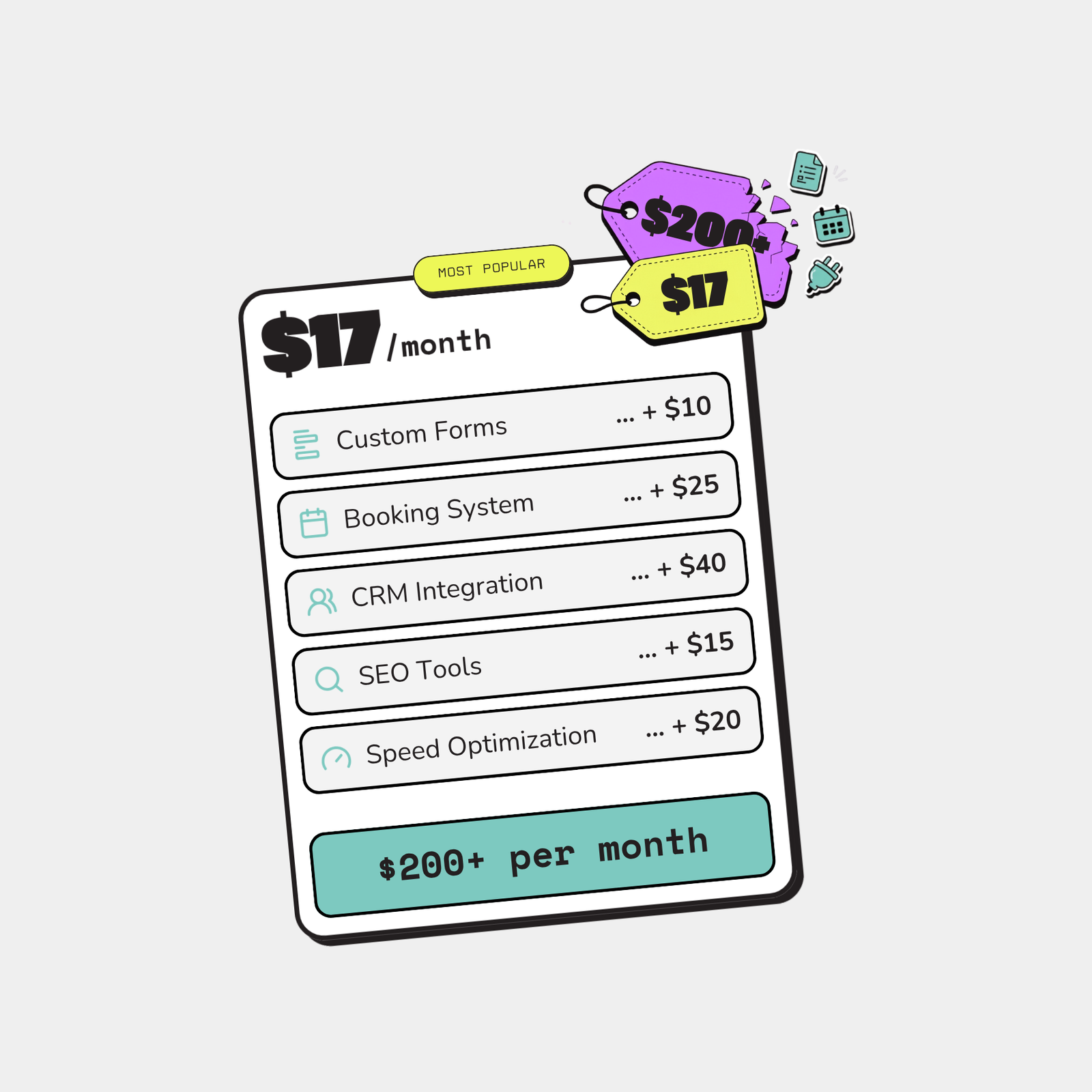
Wix and Squarespace are absolute geniuses. They didn’t build a revolutionary product, but they built one of the most successful marketing narratives of the decade. They sold you a beautiful lie. Build a professional website yourself for $17 a month, but never showed the hidden costs of DIY websites.
It sounds like a no-brainer when you are starting out. You save a few thousand dollars upfront, feel like a tech savvy founder, and launch your business. But while you are celebrating that low monthly bill, the hidden costs of DIY websites are quietly compounding every single day your site is live.
The Template Trap. Built for Everyone, Converting No One.
When you open a drag and drop builder, you choose from a library of stunning templates. They look clean, the placeholder photography is gorgeous, and the fonts match perfectly.
But there is a fundamental flaw.
Those templates were built to look pretty in a preview window, not to sell your specific service. They are designed for everyone, which means they are optimized for no one.
A high converting website requires a deep understanding of user psychology, deliberate visual hierarchy, and a strategic sales funnel. Templates don’t think about your customer’s objections or your specific value proposition. They just give you a generic box to paste your text into.
You end up with a website that looks okay but sits completely flat when it comes to turning visitors into paying clients.
The App Store Tax. When $17 a Month Becomes Hundreds.
That entry level monthly pricing is just the hook. Once you try to make your template function like a real commercial asset, the math changes completely.
You need a custom form to qualify your leads properly. That requires a premium add-on.
You need an automated booking system so clients can schedule calls without back and forth emails. That is another monthly fee.
You want to sync those leads directly to your CRM. Add another subscription to the pile.
Suddenly your cheap DIY platform is costing you hundreds of dollars a month. Even worse, you are forced to manage a fragile ecosystem of third party apps that don’t natively talk to each other.
The Hidden Costs of DIY Websites Go Deeper Than You Think
Every time you drag a new widget, add a plugin, or bolt on an app to fix a limitation in your template, you add heavy lines of unoptimized code to your site.
This creates a serious performance problem.
According to data from Backlinko on page speed benchmarks, as page load time goes from 1 second to 3 seconds, the probability of a visitor bouncing increases by 32 percent.
Most template built sites are notoriously bloated. They load slowly because the browser has to read through massive generic codebases just to display a simple headline.
You only get 3 seconds to capture a visitor’s attention. If your site is still loading its heavy hero image when that timer runs out, your prospective client has already clicked the back button.
Google Penalises Slow Websites. DIY Builders Are Slow.
It gets worse than just losing the visitors who do find you. A slow website actively prevents new people from discovering your business in the first place.
Google uses a set of metrics called Core Web Vitals to measure user experience. You can check your own site’s health directly via Google PageSpeed Insights. These scores are a direct ranking factor.
A slow website doesn’t just lose visitors. It loses Google’s trust entirely.
You can write great content and optimize your keywords all day long. If your platform’s underlying architecture is slow, you will struggle to rank on the first page. That is a massive hidden cost you will never see on your monthly invoice.
DIY Website Builders Put a Ceiling on Your Business Growth
As your business grows, your operational needs will change. You will want to build custom landing pages for targeted ad campaigns. You will want to design complex user flows or integrate advanced marketing automation.
This is where you hit the wall.
Drag and drop builders are designed to keep you inside a sandbox. The moment you need custom logic or a unique database structure, the system breaks down.
Your business deserves software that scales alongside your revenue. Moving a website away from a locked ecosystem later down the road is a painful, expensive process. It is far better to build on a scalable foundation from day one.
Your Website Should Pay for Itself. Not Cost You More.
Your website should not be a static line item on your expense sheet. It shouldn’t feel like a utility bill you pay just to exist online.
A professionally built website is a 24/7 sales machine. It filters out bad leads, warms up ideal clients, and books high value meetings while you sleep. When a site is built with proper UI/UX design and a clear funnel strategy, it pays for itself ten times over.
Stop stepping over dollars to pick up pennies with a cheap template.
If you are tired of wondering why your traffic isn’t turning into revenue, let’s take an honest look at your current setup. Head over to abdullahtallat.me and let’s figure out exactly what your DIY platform is costing your business.